Lexicoblog

The occasional ramblings of a freelance lexicographer

Monday, December 27, 2021

Patterns that go unnoticed

It’s turning into a bit of a negative end to the year … not because of anything bad happening, just because I find myself deep in a flurry of words beginning with un-. In my last post, I looked at what I’ve now discovered is called litotes; the use of two negatives together to express either irony or a subtle distinction between two absolutes (not uncommon, not unpleasant, etc.). Recently, I’ve been seeing another pattern with un- prefixed words; a kind of passive construction with go + un- + past participle:


It seems to describe events that no one sees or does anything about, things that are missed or ignored. In terms of form, it’s a bit like the get passive that we’re all familiar with, but this time the focus is on the lack of an agent doing anything. Although like most passives, we can add a by to say who didn’t notice or act … and maybe should have.


It’s also another pattern that can be used with a negative – back to litotes again. This seems to work in two ways – to talk about negative actions and events which won’t escape notice or shouldn't escape punishment:


But also to talk about positive actions and events that will be acknowledged or rewarded:


Digging a bit deeper, I realized that as well as the obvious negative verbs beginning with un-, the pattern also occurs with a handful of other verbs that have a negative meaning:


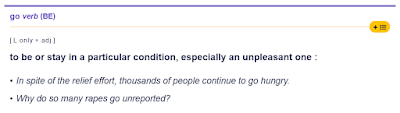
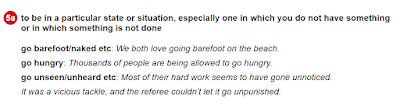
Flicking through the ELT grammar reference books on my shelves, it seems to go unmentioned. If you dig deep enough, it does feature in many dictionary definitions for go, like these from Cambridge and Macmillan, but I'm guessing it's the kind of entry that goes largely unread ...


Cambridge Dictionary


Macmillan Dictionary


Labels: , , , ,

Tuesday, December 14, 2021

Not such an uncommon pattern

I was recently researching the word unproblematic. Before I started looking at the corpus evidence, I expected that it was used to describe something that’s simple, straightforward, and uncontroversial, something that doesn’t throw up any problems. And it is, but …

As I scrolled down the concordance lines, sorting left and right as I often do when I first look at a word, I noticed a chunk of not unproblematic examples. It was a significant, but not huge proportion, so I made a mental note to investigate further when I’d dealt with the more obvious examples. As I started to look in more detail, it soon became clear that those straightforward examples, although they were there – The whole process was simple and unproblematic – were actually in the minority. What I did find was:

not unproblematic

However, the category of 'climate refugees' is not unproblematic.
However, comparing evidence from different surveys is not unproblematic.
This definition is not unproblematic, as it seems to rest on circular reasoning.
However, this approach is not unproblematic, since site reactions can cause distress to patients …

not an unproblematic + noun

Given related debates this is not an unproblematic option either.
Of course, Twitter is not an unproblematic representation of the population.
However, this is not an unproblematic undertaking.

not + (a/an) + adverb + unproblematic

balancing school and extracurricular activities is not always unproblematic
So student visas are not completely unproblematic from this point of view.
it's not an entirely unproblematic development from an editorial standpoint
The study was, indeed not wholly unproblematic
I also concluded that the idea is not so unproblematic as it might appear on first glance.
This popular mixed-mode design is not altogether unproblematic from a measurement error perspective

Miscellaneous other negatives

However, the process has not been unproblematic and has led to controversies
there can be cases where the merger cannot be characterised as unproblematic in advance.
The situation should not be thought of as unproblematic, though
That doesn't make it unproblematic
Princess Jellyfish isn't what you'd call unproblematic, but I really enjoy most of it so far

[All examples from English Web 2020 (enTenTen20) corpus via SketchEngine]

What all of these examples seem to have in common is the idea that something isn’t as simple as you might expect or as it might seem, and that in fact there may be some problems with it.

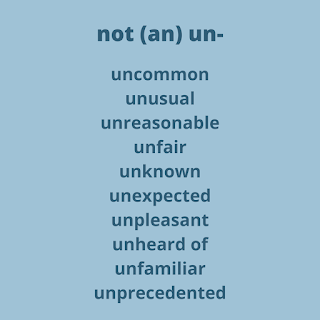
Delving further into other un- words that come after negatives, I found lots of similar patterns. Here are some of the most frequent combinations:


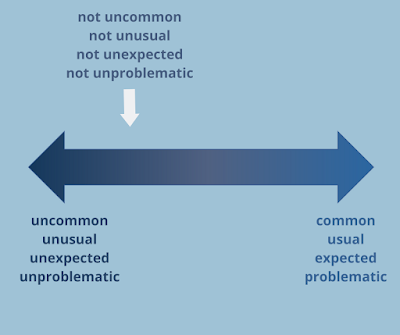
Although they don’t all work in exactly the same way and you come across different nuances of meaning in different combinations or specific examples, there does seem to be a common generalizable meaning. What many of the not + un- patterns seem to be trying to convey is:

  • a middle ground between the two antonyms – where something isn’t very problematic, common, expected, etc. but neither is it straightforward, rare, unexpected. Where that point along a scale between the two lies varies depends on context, although my feeling is it’s usually nearer to the un-


  • often the idea that something is not quite what you might expect or what it might seem. It may seem unproblematic, uncommon, unexpected, but maybe it’s not quite as much as you’d think.

And of course negatives aren’t limited to un- words – not dissimilar springs to mind – so I’m sure there’s more here to explore.

This all raises the question: have you ever seen this pattern taught, even at advanced levels? I don’t think I’ve seen it, at least not explicitly highlighted. Given it’s clearly not altogether uncommon, it’s certainly been added to my ongoing list of features to get a mention next time I’m writing something relevant.


And for those who're interested:


Labels: , , , ,

Thursday, October 07, 2021

Don’t come asking me!

This morning, I spotted the tweet below from Hugh Dellar. I started mulling over examples while I was having breakfast and by the time I got to my desk, my interest was piqued enough to do a few quick corpus searches.


I came to two main conclusions: firstly, that come and go can both be used in very similar ways and secondly, there seem to be three broad uses for the pattern. Inevitably, as is often the case with language, these uses overlap and there are some examples that don’t quite fit any of them.

Note: I should say that I ignored instances, especially with go, where the verb participle could just be described as an activity – go swimming, go hiking, go shopping, etc. I didn’t look at examples with something between the two verbs (which were mostly reduced relative clauses) and I also ignored go missing and go begging which seem to be more fixed phrases.

These were the top combinations I found for each verb, with examples from the enTenTen20 – an English web corpus with data from 2020. The colour-coding matches the uses below:


Sudden movements:

The examples which Hugh started off with seem to fit into the most common category which can be used with both come and go to describe a sudden and often dramatic or unexpected movement. It’s a use that’s exemplified and highlighted in most of the learner’s dictionaries and which even gets its own senses in OALD – sense 6 at come here and sense 4 at go here.

The choice of verb just indicates whether the movement is away from the speaker – He went running out the door – or towards the speaker – He came running into the kitchen.

And it can describe either a literal movement or a metaphorical one – the memories came flooding back, the offers came pouring in, etc.

Seeking out:

The second sense I started to notice was about actively seeking someone or something out. The difference between She knocked on my door and She came knocking on my door seems to be about the intent of the person knocking – they went somewhere with the specific intention of doing something.

Again, there were a few metaphorical examples – see the examples for come calling and go chasing above.

Warnings against ill-advised actions:

I found this last usage the most interesting. It seems to be mainly used with negatives and more with go – although come is also possible (Don’t coming crying to me if it all goes wrong) – and it’s used to warn people against doing something ill-advised, reckless or mischievous.

But don’t go blaming me if you find other senses I haven’t covered!


Corpus note: If you want to play around for yourself, I used CQL searches on Sketch Engine as below:

[lemma = “come”] [tag = “VVG”]

[lemma = “go”] [tag = “VVG”]


Labels: , ,

Monday, March 07, 2016

Teaching about vocabulary: Colligation


Recently, I gave a talk at an EAP conference at St Andrews University about encouraging EAP students to learn vocabulary independently. I argued that rather than trying to teach students all the vocab items they need to know in class (arguably an impossible task), it’s more effective to teach them about vocabulary. By that I mean, teaching about some of the key features of English (academic) vocabulary that will help students to better understand the words they come across in their studies; to know what to look out for and how to find out more (using dictionaries, etc.).

I mentioned several features of vocabulary that teachers might focus on in class including lexicogrammatical features (e.g. countable and uncountable nouns), word formation, collocation, dependent prepositions, register and connotation. The feature that people seemed less familiar with, and which several people asked me about, was colligation. I’ll fess up now that despite having been involved in dictionaries and vocab teaching for many years, it’s a relatively new term to me too. That’s not to say I wasn’t familiar with the general concept, but I didn’t have a nice neat term for it.


So where collocation is the inclination of lexical items to appear together, colligation is the tendency of words to appear together with particular grammatical structures or forms. Probably the most obvious example that appears in coursebooks is where particular words are typically followed by a verb in an infinitive or gerund form; decide to do, enjoy doing, tendency to do, avoid doing, etc. But it can also include, for example, the way that certain words tend to be used in negative constructions;

There seems to be no need for government regulation.
Established universities have traditionally not felt the need to market their services.

It’s the kind of information that learner’s dictionary typically highlight in example sentences, either by bolding the key elements or sometimes using a ‘frame’;

[+ to infinitive] I can’t afford to buy a house.
[+ that] The Prime Minister has announced that public spending will be increased next year.
(Examples from Cambridge Advanced Learner’s Dictionary)

I think it’s an under-exploited area in the classroom. Beyond an occasional activity on the following gerund/infinitive thing, I suspect colligation issues mostly get picked up in feedback (when students have come up with an awkward colligation in their writing) rather than being highlighted proactively.

As with the other features, I’m not a fan of presenting students with long lists of colligations, but raising awareness of the way that particular words behave grammatically as they crop up is, I think, a key part of helping students to notice patterns and to hopefully use vocabulary more fluently and effectively.

* Hunston, S. (2001) Colligation, lexis, pattern, and text

Labels: , ,