Lexicoblog

The occasional ramblings of a freelance lexicographer

Monday, September 02, 2019

Walking away from my desk


Friends with conventional jobs often say that they wouldn't have the discipline to work from home. I think they imagine me lounging around in my pyjamas and watching daytime TV. To be honest, after almost 20 years of freelancing, I probably suffer more from the opposite problem. Especially when I'm busy with several projects at the same time and deadlines are coming thick and fast, the greater danger is in spending too long at my desk.

As an RSI sufferer, I've always been conscious of taking regular breaks and yes, going downstairs to the kitchen to make a cup of tea and maybe hang the washing out while I wait for the kettle to boil is a good way to take those much-needed regular physical breaks from a focused, tense posture at my desk. It's not enough on its own though. Last winter, I found myself 'home alone' with my partner working abroad for a few months and with grey, uninspiring weather outside, it was all too easy to spend all day at my desk and some days to not leave the house at all. Going out for regular daytime walks was already a part of my routine, but one that tended to slip when the weather was bad or when I had a deadline looming or was just feeling a bit low and couldn't be bothered.

Photo looking down at walking shoes in a puddle in the rain
#wetwalking

#walk1000miles2019
Then friend and ELT colleague, Karen White told me about a walking challenge to walk 1000 miles during the calendar year (that's about 1600km). It's a semi-organized thing which you can sign up for or which you can just decide to do individually and you can set your own rules about what counts. I already walk quite a bit generally because I don't own a car and walking is the main way I get about. What I needed though was to get out regularly for conscious breaks that were just about walking and fresh air and clearing my head, not nipping to the supermarket to get some groceries. So I decided to log just those 'proper' walks using an app on my phone.

To do 1000 miles in a year works out at around 83 miles a month or 20 miles a week or 3 miles a day.  From where I live I can do a walk of just over 3 miles around Bristol harbour which takes me between 45 mins and an hour depending on how fast I walk and whether I stop en route to take photos or get stuck crossing roads. That doesn't sound too difficult until you realize you need to do that EVERY day .... you miss a day and you have to fit in 6 miles the next!
Screenshot of my walking app showing my regular route
My regular route

I've just reached the two-thirds point in the year and so far I'm bang on target with 669 miles walked to the end of August. Looking back at my stats, I don't generally manage to walk every day, but I typically fit in my 20 miles a week spread over about 5 days. The missed days tend to be when I just can't fit in a walk because of other commitments in the day. I also swim twice a week and I can't always justify an hour out of my working day to swim and an hour to walk, although I do have some swim+walk days.  And although I do walk in all weathers, I am occasionally put off when it's really heaving with rain.

I mostly do my regular route around Bristol harbour just because I can go out on autopilot without having to plan. And it's a great route with so many different things to see, people to watch and stuff going on. I've developed a few other regular routes too, including a couple of good 5-milers for when I need to catch up on my mileage. 

Photo of Bristol harbour in the snow
A snowy harbour walk
Photo of old cranes and a steam train
Cranes and a steam train on a grey day

Photo of an old boat in dry dock for repairs
Always something to see in Underfall boatyard
Photo of Bristol harbour in the sun with sailing boats on the water and colourful houses overlooking
A sunny day on the harbour

The #walk1000miles2019 challenge has definitely kept me motivated to keep it up as has sharing my walking with friends on social media and via the #StetWalk hashtag on Twitter which aims to encourage editors and writers to get out and away from their desks - 'stet' being an editing term meaning 'let it stand'. 
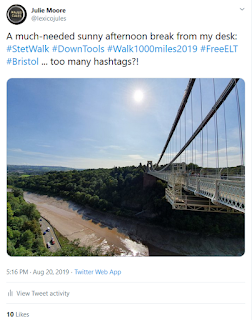
A Tweet showing a photo taken from Cifton Suspension Bridge and a tweet with the hastag #stetwalk

Has it made a difference? I think it has. It definitely kept me from slipping into depression through some of the more miserable, lonely winter months. Not only did the actual walking and fresh air often perk me up and give me a sense of achievement, but coming up with suitable photos to share on social media - even if they were rather grey and soggy - gave me a reason to stay connected.

It was helpful during a lull in work at the start of the year, giving me a regular activity to plan my days around. And more recently through a particularly busy, full-on patch of work juggling numerous different projects, when it felt like I had a hundred things whizzing around my head, an hour out walking often either let me switch off completely and come back and start afresh or else it helped me settle everything back into order and get stuff back in perspective.

Will I be doing #walk1000miles2020? Probably not, but I'll definitely be trying to keep up the habit for the sake of both my physical and mental health.

Labels: , , , , ,

Thursday, February 28, 2019

Four things I’ve learnt from working with chronic pain


The last day of February every year is International RSI Awareness day. And this year, for me, marks 20 years since I was first diagnosed with RSI. So, it seemed like a good point at which to look back on how chronic pain has affected the way I live and work over the past two decades.

To quickly recap, I started suffering the classic symptoms of RSI, shooting pains in my right hand and wrist, not long after I’d switched from a career as a classroom EFL teacher to one working all day every day at a computer in ELT publishing. Over the period that followed, I learnt a lot about repetitive strain injury and how it’s caused by sitting in a tense awkward position, often with a poor desk setup, doing small repeated movements, especially with a mouse. 

I also discovered that my pain issues stretched far beyond my right hand and that initial crisis was a trigger for a whole load of underlying musculoskeletal problems. As well as the sensitisation of the nerves running through my right hand, arm, shoulder and neck, I discovered that an old shoulder injury turned out to be a permanently dislocated collarbone which was making my whole right side wonky and unstable. Then, added into the mix was a degree of hypermobility, a condition that means that my skeleton and the tendons attached to it are particularly loose and stretchy, meaning that my frame can’t take the strain of holding my body in one position for very long. All of which has led to a messy chronic pain condition that’s had a huge impact on my life and work. It’s a topic I could write about endlessly, but here are the top four things I’ve learnt.


#1 Pacing myself
I soon discovered that I couldn’t manage a regular full-time job. I have good patches and bad patches, I’m better at working in short bursts with breaks in between and I have to fit my work around what I can physically manage. So, being freelance gives me more freedom to manage how and when I work. For any freelancer though, trying to achieve a schedule that gives you a steady flow of work is an incredible challenge. Work comes in fits and starts, projects get delayed, they run over, and sometimes get cancelled altogether. Most freelancers end up agreeing to more than they’d like just so that if one thing’s delayed or cancelled, they have something else to cover the time. And then when it all comes at once, they put in extra hours, work evenings and weekends, and just juggle their time to fit it all in. For me, however, that’s not an option. I simply can’t afford to get into a position where I’m working extra hours because my body will break down and everything will grind to a halt. That means I have to be conservative about the amount of work I take on, only agreeing to as much as I can reasonably cope with; 15-20 billed-for hours a week is ideal, 25 for the odd week at a push. That leaves me really vulnerable to those delays and cancellations though. If I’ve only got one project in my diary and that suddenly disappears at short notice, then I simply have no money coming in. I’ve got used to having a significantly lower income than my peers, but at times, with bills to pay and nothing in the bank, it’s definitely a source of stress and frustration.

#2 Avoiding the fiddly bits
Contrary to many people’s impression of RSI, for me at least, straightforward typing isn’t particularly problematic. That’s especially true with ELT materials where you’re very rarely typing long stretches of text, it’s mostly short sentences with thinking time in-between and doesn’t put that much strain on my hands. What gets me is all the fiddly stuff navigating around documents and formatting text either using a mouse or repeated keystrokes (such as lots of paging up and down). Although I use a graphics tablet instead of a mouse because I find it more comfortable, there are still certain things that are really problematic. My biggest bugbear is anything that involves highlighting specific sections of text, in order to cut and paste, or change the format. Trying to highlight exactly the right words and characters involves a degree of tension and control in your hand and wrist no matter what device you’re using and it’s that focused tension that really causes me the most pain, especially if it’s repeated over and over again.


I’m perfectly happy just typing text into a straightforward Word document and even using a template with Word styles isn’t a problem once you get into the swing of it. The projects I hate are the ones, often for digital materials, that require you to fill in lots of different fields with codes for exercise types, that involve copying and pasting the same instructions numerous times, repeating the same text for answer keys and audio scripts and artwork directions. I’ve worked on a couple of projects where getting the initial content down “on paper” took up a fraction of the time compared with filling in field after field of text in what amounted to no more than data input. Those are the jobs that I now avoid.


#3 Not standing around
Perhaps the number one most frustrating aspect of my health though is something that affects me both socially and professionally. For me, standing around for any length of time gets really uncomfortable. It can be a tricky one for people who know me to get their head around because in many ways I’m quite fit. I walk a lot – I’m currently walking around 20 miles a week as part of a walking challenge – and I don’t look like a hobbly old lady. But for me, there’s a huge difference between walking along at pace and standing around or even mooching about slowly – it puts my body under a whole load of different strains. On a bad pain day, just standing about for a few minutes can leave me unable to think about anything other than sitting down in a comfortable chair. Add to that standing around holding a drink (really painful for my arm and shoulder) or standing around with a bag on my shoulder (so uncomfortable I now avoid it at all costs) and the prospect of any kind of social or networking event that isn’t going to involve comfortable chairs fills me with dread.

It’s a real killer, because I really enjoy being sociable and chatting to people, whether they’re friends or colleagues. But unless I’m going into a situation that I’ll be able to control, such as meeting in a café where I know we’ll sit down, I find myself avoiding situations where I might end up  uncomfortable, distracted and wishing I could leave. That gets amplified at events which I’ve had to travel to (another potential source of discomfort) and at which I’m going to have to spend extended lengths of time without any respite.  It makes me feel like an unsociable grouch which I’m really not … honest!

#4 Perspective
If all that’s sounding a bit negative, there is one major positive to having a chronic health condition and that’s the perspective it gives you on life. For me, work-life balance isn’t a luxury add-on, it’s absolutely essential. If I’m overdoing it, my body will tell me so in no uncertain terms and I have no choice but to listen. I’ve learnt not to let my working life get out of perspective. That’s not to say I don’t ever get annoyed and frustrated by stuff, but I’m pretty good at stepping away from my desk, taking a break, going out for a walk, then coming back and dealing with the problem before it gets out of hand. Over the years, I’ve got better at standing my ground, speaking up when expectations are unrealistic and if necessary, just walking away. I love my work and I want to do a professional job, but you know, sometimes there are just more important things.

... like a cup of coffee in the sunshine ...

Labels: , , , , , ,

Monday, August 13, 2018

Not working


Today is my first proper day back at my desk after roughly seven weeks of not working. That might sound like a fabulous long holiday, but it was actually an extended break to try and get my health back on track.

As some of you will know, I suffer from a chronic pain condition which makes managing work a bit of a juggling act at the best of times. My condition fluctuates enormously. I have good patches and bad patches, some long, some short, some which coincide with busy patches of work, some which don’t. At the start of this year, things were particularly bad. I put it down to a combination of several busy projects back-to-back and the cold, damp, winter weather. As winter finally morphed into spring though and my workload settled down to what should have been a very manageable level, by the beginning of May my pains were even worse than ever and I was struggling to work at all. So I decided that maybe it was time for a complete break and an extended period of rest.

I finished a project at the end of June and made the decision not to take on any more work for the rest of the summer. As a freelancer, that’s quite a scary step because no work means no income. I figured though that I probably had enough in the bank to eke out a few weeks off if I budgeted carefully.

Not working

As a freelancer, you have to be pretty self-motivated, so you get used to just getting up in the morning and getting on with work. On the whole, I enjoy my work, so motivation isn’t usually a problem, and even when I’m feeling less excited about a project, just clocking up the hours and working towards the next invoice holds a certain satisfaction too. Given that mindset, not doing anything turns out to be actually quite difficult.

My natural reaction was one of: woo-hoo, time off to do lots of other stuff and fabulous summer weather too! But of course, the whole point of the exercise was to physically rest, so energetic gardening or DIY or days out traipsing around shops or galleries were also off the cards because they’re all just as likely to aggravate my pains. So, what have I been doing?

Taking it gently 

I’ve been perfecting the art of “pottering”. Rather than rush at things full throttle, I've picked a couple of small jobs each day, spaced them out, taken time wandering to the post office, maybe stopping off for a coffee en route. The hot weather helped to slow me down - you can’t rush anywhere when it’s 30°C! 


I haven’t always managed life in the slow lane smoothly though. When you’re used to being busy, it’s surprisingly difficult to change gear. Some days, I got it spot-on with enough achieved in a day to be satisfying but without overdoing it. Other days, I faffed about and didn’t really settle to anything and got to the end of the day feeling listless and frustrated. I had to keep reminding myself that even if I’d done nothing else, I’d achieved “resting”.

Not dropping off the radar

I made a decision early on that I didn’t want to switch off from work completely. Partly, that’s because I didn’t want to give the impression of being “unavailable” for fear that the unavailable tag would stick in people’s minds far beyond the summer. And partly, I just enjoy the social part of my work. I like keeping up with what people are up to and joining in the social media chat. Plus, without the cash or the energy to rush around visiting friends, it would have been easy just to sit at home and feel isolated. That means that I’ve been spending a bit of time most mornings at my desk browsing through social media, commenting or re-tweeting, reading the odd interesting article or blog post and writing a few blog posts of my own too. 


Easing back in

So, my pains have calmed down enormously now. I’m still achy and not completely pain-free, but after 20 years of chronic pain, I know not to expect miracles! I think I feel ready though to ease back into work. Plus, I’ve started getting twitchy about not working and I really need to start earning again. I’m determined to take it gently though. The first project on my desk should be about 2 weeks’ work, so I’m starting it 3 weeks before the deadline to give myself plenty of leeway.

Looking ahead, I’m making all my usual resolutions to work smart – to spend short bursts at my desk and take plenty of breaks, to pay attention to my posture, to keep exercising regularly, to use my voice recognition software a bit more and to keep my workload at a sensible level. Yes, I know, all easier said than done - especially the last one! - but I’m definitely going to try.

Labels: , , ,