Lexicoblog

The occasional ramblings of a freelance lexicographer

Saturday, September 17, 2022

Why isn’t the Wordle word in the dictionary?

Yesterday, I had a rare fail on Wordle … and it seems so did a lot of other people judging by the uproar on Twitter. 

Interestingly, I was slightly less indignant than most as the correct answer, parer, seemed like a perfectly reasonable word to me. In fact, and you’ll just have to believe me on this, it was one I’d thought of trying. It’s a tool you use to pare fruit, vegetables, or cheese, usually a small knife or a peeler. What surprised me more was that it doesn’t appear as an entry in any of the major online dictionaries – if you type it in, you either get nothing or redirected to the entry for the verb, pare. I also notice as I type this post, my spellcheck is underlining it as an unrecognized word too.

Intrigued, and slightly doubting my own intuitions, my next port of call was a corpus search. It turns out it isn’t exceptionally common, and it’s difficult to get exact stats because of noise (names, foreign words, etc.), but there are certainly plenty of examples of usage out there, mostly in recipes and adverts for knife sets.


So why isn’t the word in any of the dictionaries? How did we miss it? Dictionary editors do regularly check for new words to add to a dictionary, especially when they’re compiling new editions. It isn’t an exact science though. New coinages and buzzwords jump out and get noted down. Sometimes words get noticed and noted by lexicographers when they’re working on an entry for another word. Several online dictionaries also have facilities for users to add suggested new words. Old, but relatively rare words though are easily missed.

But has parer actually been missed?

Learner’s dictionaries, of course, focus on the more high-frequency words that are likely to be most useful to learners of the language, so parer would be unlikely to feature anyway. And the free online versions of general reference dictionaries aren’t always based on the most comprehensive version of that publisher’s dictionaries. So, you won’t, for example, find the full OED available for free online, it’s a subscription service. Although, in fact, you don’t even have to go to the full OED to find parer. The entry below, in which parer appears at least as a run-on if not a headword, is from the Oxford Dictionary of English, a slightly less weighty, single-volume dictionary. Similarly, I found it in an old print version of The American Heritage College Dictionary I have on my shelves.


Oxford Dictionary of English, 3e

So, I went back to online sources and found that if you scroll down to the second entry for pare on dictionary.com, which has recently taken on data from Oxford Dictionaries, you do find it hidden away there too. 


So, before you exclaim that a word isn’t in the dictionary, perhaps you need to consider which dictionary you’re looking in and how much you can reasonably expect to get for free online.

Labels: , ,

Monday, January 17, 2022

Lexicography FAQs: hard words

The other night I dreamt that I had an app on my phone that kept pinging obscure words at me that I had to define at the same time as I was trying to pack up to move house. 


Having been deep into a lexicography project for the past few months, I’m loving being paid to play with words all day, but at the same time, it’s clearly messing with my head!

It made me think of one of the questions that people often ask when I say I’m a lexicographer - how I know what the ‘hard’ words mean. My first response is usually that as someone who works primarily on ELT dictionaries, we tend not to get very many ‘hard’ words to deal with. Learner’s dictionaries focus more on high frequency words because they’ll be the ones learners are most likely to come across and need to know. Back in the days of print dictionaries, space constraints largely dictated which words would be included. Crudely speaking, we started with the most frequent words and worked our way down the frequency list until we’d filled the number of pages we had space for. Of course, in a more digital age, those constraints no longer apply and the distinction between learner’s dictionaries and those aimed at L1 English speakers is becoming more blurred.

Frequency notwithstanding though, at the top end of advanced learner’s dictionaries, you do sometimes come across words you’re not familiar with and over the years, I’ve worked on a number of projects that have gone beyond the confines of general ELT, such as working on the Oxford Learner’s Dictionary of Academic English and on non-ELT projects, including the Oxford Dictionary of English. So, yes, I do have to deal with words that are either right on the edges of my knowledge or that I just don’t have a clue about.

Connections and derivatives

At the easier end of the scale, you’re sometimes faced with words that are related to those already covered in the dictionary you’re working on. A lot of my work on ODE, for example, was adding or upgrading run-ons – words that are tagged onto the end of other entries but don’t get a full entry and definition of their own. So, you might find contentedly and contentedness as run-ons at the end of the entry for contented.
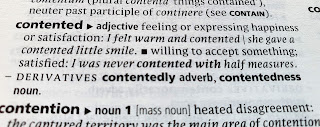
Oxford Dictionary of English (3e)
 

If you’re upgrading a run-on to a full entry, it’s sometimes as simple as adapting the definition from the existing entry to the new part of speech and adding some examples. You still need to do a corpus check though – firstly to source the examples, but also to make sure the word does just mirror its root word in terms of usage. For example, looking at corpus cites for the word deportable recently, it was immediately clear that it broadly means “can be deported”, but a closer look revealed that a person can be deportable – a deportable immigrant/foreign national – but there are also deportable crimes/offences, i.e. ones that someone can be deported for. So, both of these uses needed to be reflected in the entry.

Checking other dictionaries

Another question I often get asked is whether we just copy stuff from other dictionaries. The answer is “No, but …” Dictionaries all have their own style guidelines which dictate how definitions are worded. Learner’s dictionaries have a defining vocabulary; a list of words you’re allowed to use in definitions. There are pages of guidelines about all the other little details such as register labels, regional and spelling variants, and how grammatical information, collocations, etc. are shown. And examples are all drawn from the specific publisher’s corpus, along with guidelines about how many examples to include, how they should be edited, presented, etc.

That said, I do often consult other dictionaries to check my intuitions. I’ll always look at the corpus data first and try to form my own impression of a word, even if in the case of completely unknown words, it’s a bit of a vague one. Then I’ll look at other dictionaries, often 3 or 4 others, to see whether my impressions were in track and then go back to the corpus evidence again. Sometimes, the other dictionaries confirm quite straightforwardly what I was thinking, sometimes they highlight a usage I hadn’t spotted, so I’ll go back to the data to see whether I can find examples. Sometimes different dictionaries disagree, and very occasionally, they just don’t cover the word at all.

Other reference sources:

When it comes to specialized, technical and academic words, I often find that I need to dig a bit further. Sometimes I find myself looking at definitions from other dictionaries but feeling that I still don’t really understand the concept. That’s not to say those entries are lacking, dictionary definitions are about trying to capture the essence of a word as concisely as possible, they’re not about explaining complex concepts in endless detail.  In those cases, I seek out other reference sources, often specialist technical or academic websites that have fuller explanations. It’s one of my favourite bits of the job but can be challenging too. I’ll usually try and look at a mix of sources including some nice simple undergraduate guides if I can find them, as well as the proper technical stuff. Then when I think I’ve got my head around a concept, I’ll try and synthesize it all into an appropriate definition. When it’s an idea within the humanities and social sciences, I often feel like I’ve pinned it down well. In the hard sciences and computing though, it can feel like a half-understood approximation! I was pleased to fall back on my A level in Statistics recently when trying to understand probability density function, but found myself stumped by multi-phase and premeiotic … which is why we have:

Spec checks:

Thankfully, as lexicographers, we aren’t expected to be omni-experts! Anything we’re unsure about, we can flag up for a specialist check so it can be referred to a subject specialist … who’ll probably laugh at our lay attempts to define a techy term before they completely rewrite it!

Labels: , , , ,

Friday, January 07, 2011

Happy New Year!


I got back this week from a Christmas/New Year trip to Cambodia (above at Angkor Wat) and I've spent a couple of days trying to get over the jet lag and pottering about; doing lots of washing, sorting out photos, dealing with my inbox and sending out a few work messages. It's also inevitably a time for thinking back and looking forward ...

Highlights of 2010
  • 2010 started with the publication of Global which had been a big feature of my working year in 2009. There was the launch at the Ashmolean Museum in Oxford in February and then in November, the trip to Buckingham Palace to pick up the ESU award for the e-workbook along with several of my Global co-writers - a day to remember!
  • The summer saw the publication of the latest edition of the Oxford Dictionary of English - the first big native speaker dictionary project I've worked on, so an exciting milestone.
  • This year's big project though was work on the Collins COBUILD Key Words for IELTS books. It was, in many ways, a dream project for me, combining my lexicography skills with my recent interest in EAP and IELTS. The project also marked a bit of a step forward in career terms as I was working as senior editor for the three books; a challenging, but really interesting experience.
Resolutions for 2011

Well, there's only one really and that's to break out of the cycle of getting involved in one big project in the year that ends up being more work than I can cope with in the time available, so that my RSI flares up really badly, leaving me in lots of pain and frustrated, and then having to take time off to recover. I don't want to give up those 'big' projects, because they're usually the most interesting. But there really has to be a way of working that means that I can control my hours and work through something at a reasonable pace - as opposed to the usual promises to start on a particular date which then moves and moves and moves, until I'm left with the same amount of work to do (and usually more than expected) in half the amount of time!

So here's looking forward to an interesting, productive and sensibly-paced year ahead in 2011.

Labels: , , , , ,

Thursday, August 19, 2010

A grown-up dictionary!

It's not often that a project I've worked on gets a mention on Radio 4, but this morning, as I was trying rouse myself out of bed, the new edition of the Oxford Dictionary of English (Oxford's single-volume dictionary) got a mention on the Today programme. This was exciting, not just because things I've worked on don't often get talked about on the radio, but also because it was my first foray into native speaker dictionaries and it feels all rather 'grown-up'!


I didn't actually work on researching and writing the dictionary, but I was involved in working on the database on which it's compiled and stored; tidying up some technical stuff, making sure everything was structured and formatted correctly, checking that nothing was missing, checking links and cross-references. It was still a great experience though and an insight into a different branch of lexicography. After years of working on ELT dictionaries, where the vocabulary's all very frequent and familiar, and where the grammar's simplified for learners, at first, it was a bit daunting. I learnt loads, having to deal with grammatical distinctions that I'd never really had to think about before and coming across lots of words that were way outside my vocabulary. I may have only joined the project at the tail end, but it was still fun to deal with some 'grown-up' language for a change!

Labels: , , ,