Lexicoblog

The occasional ramblings of a freelance lexicographer

Monday, January 17, 2022

Lexicography FAQs: hard words

The other night I dreamt that I had an app on my phone that kept pinging obscure words at me that I had to define at the same time as I was trying to pack up to move house. 
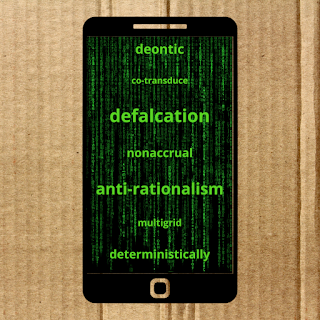
 

Having been deep into a lexicography project for the past few months, I’m loving being paid to play with words all day, but at the same time, it’s clearly messing with my head!

It made me think of one of the questions that people often ask when I say I’m a lexicographer - how I know what the ‘hard’ words mean. My first response is usually that as someone who works primarily on ELT dictionaries, we tend not to get very many ‘hard’ words to deal with. Learner’s dictionaries focus more on high frequency words because they’ll be the ones learners are most likely to come across and need to know. Back in the days of print dictionaries, space constraints largely dictated which words would be included. Crudely speaking, we started with the most frequent words and worked our way down the frequency list until we’d filled the number of pages we had space for. Of course, in a more digital age, those constraints no longer apply and the distinction between learner’s dictionaries and those aimed at L1 English speakers is becoming more blurred.

Frequency notwithstanding though, at the top end of advanced learner’s dictionaries, you do sometimes come across words you’re not familiar with and over the years, I’ve worked on a number of projects that have gone beyond the confines of general ELT, such as working on the Oxford Learner’s Dictionary of Academic English and on non-ELT projects, including the Oxford Dictionary of English. So, yes, I do have to deal with words that are either right on the edges of my knowledge or that I just don’t have a clue about.

Connections and derivatives

At the easier end of the scale, you’re sometimes faced with words that are related to those already covered in the dictionary you’re working on. A lot of my work on ODE, for example, was adding or upgrading run-ons – words that are tagged onto the end of other entries but don’t get a full entry and definition of their own. So, you might find contentedly and contentedness as run-ons at the end of the entry for contented.
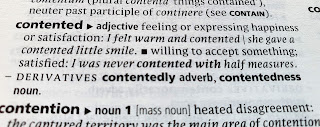
Oxford Dictionary of English (3e)
 

If you’re upgrading a run-on to a full entry, it’s sometimes as simple as adapting the definition from the existing entry to the new part of speech and adding some examples. You still need to do a corpus check though – firstly to source the examples, but also to make sure the word does just mirror its root word in terms of usage. For example, looking at corpus cites for the word deportable recently, it was immediately clear that it broadly means “can be deported”, but a closer look revealed that a person can be deportable – a deportable immigrant/foreign national – but there are also deportable crimes/offences, i.e. ones that someone can be deported for. So, both of these uses needed to be reflected in the entry.

Checking other dictionaries

Another question I often get asked is whether we just copy stuff from other dictionaries. The answer is “No, but …” Dictionaries all have their own style guidelines which dictate how definitions are worded. Learner’s dictionaries have a defining vocabulary; a list of words you’re allowed to use in definitions. There are pages of guidelines about all the other little details such as register labels, regional and spelling variants, and how grammatical information, collocations, etc. are shown. And examples are all drawn from the specific publisher’s corpus, along with guidelines about how many examples to include, how they should be edited, presented, etc.

That said, I do often consult other dictionaries to check my intuitions. I’ll always look at the corpus data first and try to form my own impression of a word, even if in the case of completely unknown words, it’s a bit of a vague one. Then I’ll look at other dictionaries, often 3 or 4 others, to see whether my impressions were in track and then go back to the corpus evidence again. Sometimes, the other dictionaries confirm quite straightforwardly what I was thinking, sometimes they highlight a usage I hadn’t spotted, so I’ll go back to the data to see whether I can find examples. Sometimes different dictionaries disagree, and very occasionally, they just don’t cover the word at all.

Other reference sources:

When it comes to specialized, technical and academic words, I often find that I need to dig a bit further. Sometimes I find myself looking at definitions from other dictionaries but feeling that I still don’t really understand the concept. That’s not to say those entries are lacking, dictionary definitions are about trying to capture the essence of a word as concisely as possible, they’re not about explaining complex concepts in endless detail.  In those cases, I seek out other reference sources, often specialist technical or academic websites that have fuller explanations. It’s one of my favourite bits of the job but can be challenging too. I’ll usually try and look at a mix of sources including some nice simple undergraduate guides if I can find them, as well as the proper technical stuff. Then when I think I’ve got my head around a concept, I’ll try and synthesize it all into an appropriate definition. When it’s an idea within the humanities and social sciences, I often feel like I’ve pinned it down well. In the hard sciences and computing though, it can feel like a half-understood approximation! I was pleased to fall back on my A level in Statistics recently when trying to understand probability density function, but found myself stumped by multi-phase and premeiotic … which is why we have:

Spec checks:

Thankfully, as lexicographers, we aren’t expected to be omni-experts! Anything we’re unsure about, we can flag up for a specialist check so it can be referred to a subject specialist … who’ll probably laugh at our lay attempts to define a techy term before they completely rewrite it!

Labels: , , , ,

Tuesday, December 14, 2021

Not such an uncommon pattern

I was recently researching the word unproblematic. Before I started looking at the corpus evidence, I expected that it was used to describe something that’s simple, straightforward, and uncontroversial, something that doesn’t throw up any problems. And it is, but …

As I scrolled down the concordance lines, sorting left and right as I often do when I first look at a word, I noticed a chunk of not unproblematic examples. It was a significant, but not huge proportion, so I made a mental note to investigate further when I’d dealt with the more obvious examples. As I started to look in more detail, it soon became clear that those straightforward examples, although they were there – The whole process was simple and unproblematic – were actually in the minority. What I did find was:

not unproblematic

However, the category of 'climate refugees' is not unproblematic.
However, comparing evidence from different surveys is not unproblematic.
This definition is not unproblematic, as it seems to rest on circular reasoning.
However, this approach is not unproblematic, since site reactions can cause distress to patients …

not an unproblematic + noun

Given related debates this is not an unproblematic option either.
Of course, Twitter is not an unproblematic representation of the population.
However, this is not an unproblematic undertaking.

not + (a/an) + adverb + unproblematic

balancing school and extracurricular activities is not always unproblematic
So student visas are not completely unproblematic from this point of view.
it's not an entirely unproblematic development from an editorial standpoint
The study was, indeed not wholly unproblematic
I also concluded that the idea is not so unproblematic as it might appear on first glance.
This popular mixed-mode design is not altogether unproblematic from a measurement error perspective

Miscellaneous other negatives

However, the process has not been unproblematic and has led to controversies
there can be cases where the merger cannot be characterised as unproblematic in advance.
The situation should not be thought of as unproblematic, though
That doesn't make it unproblematic
Princess Jellyfish isn't what you'd call unproblematic, but I really enjoy most of it so far

[All examples from English Web 2020 (enTenTen20) corpus via SketchEngine]

What all of these examples seem to have in common is the idea that something isn’t as simple as you might expect or as it might seem, and that in fact there may be some problems with it.

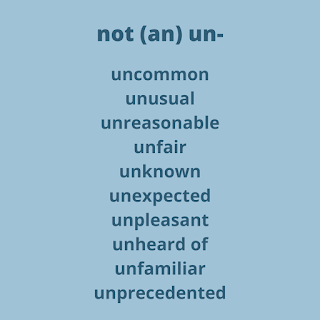
Delving further into other un- words that come after negatives, I found lots of similar patterns. Here are some of the most frequent combinations:


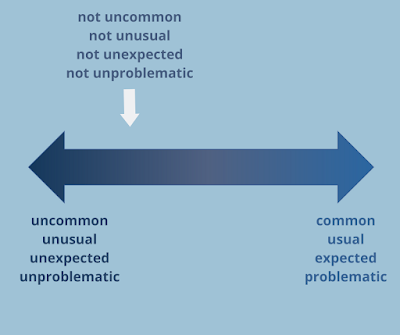
Although they don’t all work in exactly the same way and you come across different nuances of meaning in different combinations or specific examples, there does seem to be a common generalizable meaning. What many of the not + un- patterns seem to be trying to convey is:

  • a middle ground between the two antonyms – where something isn’t very problematic, common, expected, etc. but neither is it straightforward, rare, unexpected. Where that point along a scale between the two lies varies depends on context, although my feeling is it’s usually nearer to the un-


  • often the idea that something is not quite what you might expect or what it might seem. It may seem unproblematic, uncommon, unexpected, but maybe it’s not quite as much as you’d think.

And of course negatives aren’t limited to un- words – not dissimilar springs to mind – so I’m sure there’s more here to explore.

This all raises the question: have you ever seen this pattern taught, even at advanced levels? I don’t think I’ve seen it, at least not explicitly highlighted. Given it’s clearly not altogether uncommon, it’s certainly been added to my ongoing list of features to get a mention next time I’m writing something relevant.


And for those who're interested:


Labels: , , , ,

Tuesday, November 23, 2021

Eco-related language change: an #ELTCanDoECO lesson

Last week, I gave a talk at the 40th TESOL France Colloquium about language change and how it’s relevant (or sometimes not) in the ELT classroom. I mentioned several of the key drivers of language change in recent years, including the pandemic, social change, social media, and technology more generally. I also talked about newly emerging language associated with the climate crisis and reactions to it, and I wanted to share one of my ecoliteracy lesson ideas more widely.

In my session, I mentioned some of the new eco-related coinages that have appeared, such as ecocide, rewilding, degrowth and greenwashing. There has also been a proliferation of new compounds formed from existing words in new combinations; net zero, climate vulnerable, regenerative farming, etc. All of which are fascinating and great lesson fodder, but which I’m going to leave aside for now and maybe return to in another post.

As a part of the eltfootprint community, I was inspired by the recent #ELTCanDoECO initiative that encourages ELT professionals to frame ecoliteracy in terms of the kind of Can-do statements we’re already familiar with in our teaching, from example from the CEFR. The initiative is encouraging people to contribute “examples of Can-do statements that straddle environmental competencies and linguistic learning outcomes” – so here’s mine focused around not completely new words, but perhaps appropriately, words which have been repurposed and given new meanings for a new context:


… can describe everyday sustainable actions

Environmental competency aims:

  • To encourage learners to discuss ways they can reduce waste in their own everyday lives
  • To promote discussion of solutions to reducing waste in the wider community
  • To equip them with the language to express and pass on these ideas in English

Language learning outcomes:

  • To raise learners’ awareness of patterns of word formation, especially the use of the prefix re-
  • To expand their repertoire of re- verbs
  • To focus on and practise typical verb + object collocations

Level: This lesson could be adapted for any class from about A2 upwards. For lower levels, introduce fewer of the re- verbs (maybe the key 3 + 2 or 3 others) and keep the tasks simple. For higher levels, use the full range of verbs and push students to develop, expand on and explain their ideas more fully rather than just creating simple, single-sentence responses.

1. Introduce the topic and three key verbs

Use the graphic to introduce these three key verbs – reduce, reuse, recycle. Elicit their meanings and encourage students to explain/discuss their relevance in this context. The initial discussion about overconsumption and waste, how it harms the environment (depleting resources and causing pollution from waste), and how these actions can help mitigate that harm will depend on the level of the students, their existing level of awareness of the issues, and perhaps, whether it’s a topic that’s been covered in class before. 

Recycling logo + key verbs: reduce, reuse, recycle
 

Tip: Stretch higher level students by throwing in some of the vocab I just used there, like overconsumption, deplete and mitigate.

2. Re- prefix and word formation

Highlight/underline the re- in the three verbs and ask students what the prefix usually means, i.e. it carries the idea of doing something again, of repeating. Then introduce as many of the additional re- verbs below as appropriate for the level – be careful not to overwhelm lower levels with too much new vocabulary, but higher levels should be able to cope with more as a lot of the words will be at least partially familiar. Either as a class or in groups, get students to explain the meanings of the new verbs and how they’re relevant in this context. 

Recycling logo + redce, reuse, recycle, rethink, refill, recover, repair, refuse, respect, redesign, repurpose, refurbish
 

NOTE: Reduce, refuse and respect don’t use the re- prefix in the same way as the others. If sharp-eyed students spot this, acknowledge that they don’t fit the pattern, but are, nonetheless, useful for getting across the message in a memorable way. Also recover, repair and refurbish don't work as standalone verbs without the re-, but the re- still has the same meaning.

3. Identify collocating objects

In groups, get students to add possible objects that could follow the different verbs in this context, making notes or mind maps of their ideas, e.g. recycle paper, plastic, glass; repair clothes, electronic devices, household items, etc. etc. Monitor, guide, collect ideas as a class and correct/introduce any relevant vocabulary.

4. Productive practice

The next stage is to get students to expand on some of their ideas in a more productive way. This could be done in class or as homework, with students working individually or in groups. My suggestion would be an individual homework task in which students choose maybe four of the verbs plus four of the objects generated in the groupwork. They then find or take appropriate photos to illustrate the actions and create social media posts with simple text to describe the actions. My examples below are all my own photos of things that either I do or, in the case of redesign, that I see happening in my community. These could, of course, also be hand-drawn/illustrated posters or any other format you choose.


Students then bring their posts to share with the class and explain (either to the whole class as mini presentations with their posts up on screen or in groups sharing their posts on their phones). Again, the length and detail of the explanation/presentation will depend on the level of the students – for lower levels just encourage students to put the ideas into full sentences, maybe a sentence or two about each image, for higher levels, push for more details about the how and why and whether the solution is effective. Again, give feedback on any language points and encourage discussion as appropriate.

© The images in this post were all created by me - feel free to copy and reuse them with your classes if you wish.

Labels: , , , ,

Monday, July 19, 2021

Coronavocab: the pingdemic

I haven’t posted about coronavocab for a while, largely because the corpus I was using to track new words last year hasn’t kept up – and currently only has data up to Jan 2021. I should say that the folks who’ve been putting together the Timestamped JSI Web Corpus did an amazing job keeping pace last year, so it’s really no surprise that they’ve finally had to slow down.

Nevertheless, I couldn’t resist posting about this latest new coinage, just because it’s such a great creation. So, this post is based on anecdotal evidence and some googling. To explain the pingdemic though, I need to take a step back first.

be/get pinged (verb, usually passive) 

In the UK, the National Health Service (NHS) introduced a phone app last year that’s designed to track coronavirus infections. Apparently, it’s been downloaded by millions of people. It works in two main ways, firstly it uses Bluetooth to detect whether you’ve been in close contact with someone who later tests positive for Covid-19, i.e. you’ve been close to them for more than about 15 minutes.


You also use it to check in to places like restaurants by scanning a QR code, so that if there’s an outbreak connected to the venue, you can be alerted.


And if you receive a notification via either of these methods, you get pinged to tell you to self-isolate for 10 days.

If I get pinged, there is only me - so the shop would have to close. (BBC) 

More than half a million people in England were "pinged" by the NHS Covid-19 app in a single week (ITV news)

Employers report staff shortages as thousands of workers pinged (Personnel Today) 

What do I do if I am pinged by the NHS Covid-19 app? (The Times) 

More people in Leeds were 'pinged' by the NHS Covid app than anywhere else in the country last week (Yorkshire Evening Post) 


pingdemic
(noun) 

In recent weeks, the number of infections in the UK has increased dramatically – although thankfully, with many people now vaccinated, those cases have largely been mild or asymptomatic. Along with that, thousands of people are getting pinged every day resulting in a pingdemic where increasing numbers of people are being told to self-isolate, leading to many businesses being short-staffed or even forced to close.

NHS Test and Trace is penetrating through walls and forcing neighbours to self-isolate in the latest sign of a ‘pingdemic’. (Metro) 

Amid both the pingdemic and face mask rule confusion, we asked our readers what they are most worried about this summer (Telegraph) 

Bin collections have also been hit by the pingdemic in Wyre council in Lancashire. (Guardian) 

The cause appears to be the so-called “pingdemic”, with essential staff being told to self-isolate because they have been in contact with a coronavirus case. (Independent) 

Inevitably, this is going to be a fairly short-lived new term, but I still find it oddly pleasing – what with the light-hearted nature of the word ping which brings a bit of fun amongst the gloom and also because it just mirrors the word it’s based on so nicely. 


double-jabbed
and fully-vaxxed (adjectives)

One reason why the pingdemic might not be with us for too much longer is that in a few weeks, the guidelines are due to change so that people who’ve been double-jabbed and fully-vaxxed will no longer have to isolate and will instead just be asked to take a Covid test.

From 16 August, double jabbed individuals and under 18s will no longer need to self-isolate if they are identified as a close contact of someone with COVID-19 (UK government website) 

Double-jabbed Britons have been given the green light to jet to holiday hotspots like Greece and Italy this summer without quarantine. (Evening Standard) 

People who have not been double jabbed will have to test negative for COVID-19 within 24 hours of arrival in France if they are travelling from the UK, Spain, Portugal, Cyprus, the Netherlands and Greece. (Sky News)

The phenomena of the double x in vaxx (short for vaccine/vaccinate) is an odd one. Other verbs ending in x don’t double their final consonant; taxed, faxed, relaxed. It’s not a new coinage as it’s been used in the context of anti-vaxxers (people opposed to vaccination) for several years – and it may have originated in the controversial anti-vaccine film; “Vaxxed”. Whatever its origins, in the past few months it’s blossomed - and freed itself of those connotations.

Two-thirds of adults in the UK are now double-vaxxed  (City AM) 

Canada may let fully vaxxed Americans visit next month (The Suburban) 

Work ongoing to understand the profile of fully vaxxed people with severe outcomes. (Metro) 

Can anyone out there confirm I have this right for what is needed to travel from UK to Majorca next week please - both adults double vaxxed last jab a month ago. (Mumsnet)

Interestingly, that last example, a comment from an online forum, shows how while pingdemic is probably more one for journalists and headline writers, being pinged, jabbed and vaxxed have all passed into people's everyday vocabulary.

We’ll have to wait and see how long the pingdemic lasts and what new coronavocab coinages continue to emerge as the situation develops …

Labels: , ,

Friday, February 05, 2021

Motivation, mindset and guessing vocabulary from context

When it comes to ELT vocabulary, the idea of guessing the meaning of unknown words from context seems intuitively a useful strategy. However, its effectiveness both in terms of reading comprehension and how well it helps learners retain new vocabulary has been questioned – see this blogpost from Philip Kerr for a summary of some of the arguments. I just went back to reread it after something that happened yesterday.

Since my partner recently took Swiss citizenship (via his father), we've been receiving regular piles of paperwork from the canton in which he's registered. It's mostly to do with voting, either in referenda or local elections and is all in French. We both speak some French, but far from fluently.

A pile arrived yesterday and I was flicking through it, mostly just to practise my French as I waited for the kettle to boil on a tea break. There were three referenda questions, two of which I understood quite easily, the third I hesitated over. 


Image of red booklet with referendum question

It read: "l'interdiction de se dissumuler le visage." Which I read as "Prohibition/Ban on [reflexive verb which I don't recognize] the face." My first thought was it might be something to do with banning facial recognition software or something similar – it was about banning something to do with people's faces and based on my current world knowledge, that seemed like a logical guess. I read the first paragraph and it initially seemed to fit – it talked about the ban applying in public places such as in the street, on public transport, in sports stadiums, etc.

I still wasn't quite sure though, so I scanned through a bit more of the text. Then I came across a section about the arguments in favour of the ban and it said that "[the noun from the unknown verb] of the face in public spaces symbolises the oppression of women and is against the liberal spirit of living together/community cohesion". Aha! It was at that point that I realized that dissumuler means to conceal or hide or cover and that the question was about face-coverings – presumably in the sense of a niqab rather than a medical face mask (the irony of the timing wasn't lost on me!).

That aha moment was incredibly satisfying – perhaps an under-rated motivator in language learning? Or is that just me? It often strikes me that teachers and linguists, who are inherently fascinated by language for its own sake, may not be the best people to judge what works and what doesn't for the average language learner for whom learning a language may just be a means to an end. Does the average learner get that same sense of achievement from working out meaning? Would they have bothered to form a hypothesis then read on to check it in the way that I did or would they have just given up? It's hard to say and I'm sure it would differ enormously from student to student.

And of course, now I'm not going to be able to fairly judge whether my experience of guessing from context is going to help me retain the new vocab item either. Chances are I will just because I've done the diligent language-learner thing of processing and working with my new word by writing a blog post about it!

Labels: ,