Lexicoblog

The occasional ramblings of a freelance lexicographer

Monday, September 02, 2019

Walking away from my desk


Friends with conventional jobs often say that they wouldn't have the discipline to work from home. I think they imagine me lounging around in my pyjamas and watching daytime TV. To be honest, after almost 20 years of freelancing, I probably suffer more from the opposite problem. Especially when I'm busy with several projects at the same time and deadlines are coming thick and fast, the greater danger is in spending too long at my desk.

As an RSI sufferer, I've always been conscious of taking regular breaks and yes, going downstairs to the kitchen to make a cup of tea and maybe hang the washing out while I wait for the kettle to boil is a good way to take those much-needed regular physical breaks from a focused, tense posture at my desk. It's not enough on its own though. Last winter, I found myself 'home alone' with my partner working abroad for a few months and with grey, uninspiring weather outside, it was all too easy to spend all day at my desk and some days to not leave the house at all. Going out for regular daytime walks was already a part of my routine, but one that tended to slip when the weather was bad or when I had a deadline looming or was just feeling a bit low and couldn't be bothered.

Photo looking down at walking shoes in a puddle in the rain
#wetwalking

#walk1000miles2019
Then friend and ELT colleague, Karen White told me about a walking challenge to walk 1000 miles during the calendar year (that's about 1600km). It's a semi-organized thing which you can sign up for or which you can just decide to do individually and you can set your own rules about what counts. I already walk quite a bit generally because I don't own a car and walking is the main way I get about. What I needed though was to get out regularly for conscious breaks that were just about walking and fresh air and clearing my head, not nipping to the supermarket to get some groceries. So I decided to log just those 'proper' walks using an app on my phone.

To do 1000 miles in a year works out at around 83 miles a month or 20 miles a week or 3 miles a day.  From where I live I can do a walk of just over 3 miles around Bristol harbour which takes me between 45 mins and an hour depending on how fast I walk and whether I stop en route to take photos or get stuck crossing roads. That doesn't sound too difficult until you realize you need to do that EVERY day .... you miss a day and you have to fit in 6 miles the next!
Screenshot of my walking app showing my regular route
My regular route

I've just reached the two-thirds point in the year and so far I'm bang on target with 669 miles walked to the end of August. Looking back at my stats, I don't generally manage to walk every day, but I typically fit in my 20 miles a week spread over about 5 days. The missed days tend to be when I just can't fit in a walk because of other commitments in the day. I also swim twice a week and I can't always justify an hour out of my working day to swim and an hour to walk, although I do have some swim+walk days.  And although I do walk in all weathers, I am occasionally put off when it's really heaving with rain.

I mostly do my regular route around Bristol harbour just because I can go out on autopilot without having to plan. And it's a great route with so many different things to see, people to watch and stuff going on. I've developed a few other regular routes too, including a couple of good 5-milers for when I need to catch up on my mileage. 

Photo of Bristol harbour in the snow
A snowy harbour walk
Photo of old cranes and a steam train
Cranes and a steam train on a grey day

Photo of an old boat in dry dock for repairs
Always something to see in Underfall boatyard
Photo of Bristol harbour in the sun with sailing boats on the water and colourful houses overlooking
A sunny day on the harbour

The #walk1000miles2019 challenge has definitely kept me motivated to keep it up as has sharing my walking with friends on social media and via the #StetWalk hashtag on Twitter which aims to encourage editors and writers to get out and away from their desks - 'stet' being an editing term meaning 'let it stand'. 
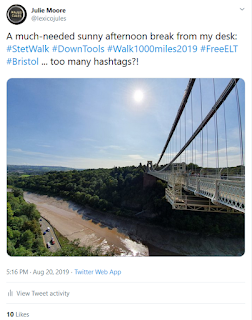
A Tweet showing a photo taken from Cifton Suspension Bridge and a tweet with the hastag #stetwalk

Has it made a difference? I think it has. It definitely kept me from slipping into depression through some of the more miserable, lonely winter months. Not only did the actual walking and fresh air often perk me up and give me a sense of achievement, but coming up with suitable photos to share on social media - even if they were rather grey and soggy - gave me a reason to stay connected.

It was helpful during a lull in work at the start of the year, giving me a regular activity to plan my days around. And more recently through a particularly busy, full-on patch of work juggling numerous different projects, when it felt like I had a hundred things whizzing around my head, an hour out walking often either let me switch off completely and come back and start afresh or else it helped me settle everything back into order and get stuff back in perspective.

Will I be doing #walk1000miles2020? Probably not, but I'll definitely be trying to keep up the habit for the sake of both my physical and mental health.

Labels: , , , , ,

Wednesday, February 28, 2018

Give yourself a break


The final day of February every year is International RSI Awareness Day, so it’s a good time for a reminder to take care of yourself when you’re working at a desk all day. In the past, I’ve written about posture and desk set-up – which are both incredibly important – but this year, the main thing that I’ve been struggling to get right, and which I think a lot of freelancers will recognize, is keeping my working hours under control.

One of the main causes of health problems related to working at a desk is simply overworking. If there’s something a bit awry with your posture or desk set-up, then long hours pushing your body is only going to exacerbate any niggling, underlying issues. And, to be honest, even if your set-up’s spot-on, too many hours in one position and your body’s going to get tired and tense and your posture’s going to slip and that’s when problems start. As someone who suffers from chronic pain, keeping an eye on the number of hours I spend at my desk is one of the most important tools I have in managing my condition.

In an ideal world, I’d work roughly 20 billed-for hours a week (actually working on paid projects) plus around 5-10 hours of ‘admin’ (sorting out emails, book-keeping, social media, reading, writing blog posts, etc.). Those hours would be evenly spread through the week and also spread through the day with plenty of breaks and no more than an hour at my desk at a time (with mini breaks within that hour). And I’d just plod along happily.

At the start of each week, I have in mind a rough ‘shape’ for the week ahead, that generally consists of:

One ‘disrupted’ day, when I might take the whole day out at an event or I might have a half-day away from my desk. That could be meeting a friend for lunch or booking in a one-to-one pilates class.

A swim twice a week. I generally go at the end of the morning and it’s a great way to stretch out and release the morning’s tensions. I also find it’s great thinking time … lots of activities get composed as I’m gliding up and down the pool!

An hour away. On other days, I try to get completely away from my desk for at least an hour at some point during the day. I’ve taken to going for a brisk walk with a favourite route around Bristol harbour (about 3.5 miles/5.5 km) which takes me about 50 minutes. Or I might just take a roundabout route to the Post Office or to do some other chore.

Bristol harbour

In reality, over 18 years of freelancing, I’ve rarely managed to keep a steady flow of work. However, hard you try to plan, schedules shift, briefs expand so you find yourself doing double the hours in half the time and projects overrun, overlapping with the next one and eating up your planned downtime. And even when you push back, deadlines only move minimally and grudgingly.

So, what’s the answer to avoiding overwork and keeping a healthy workflow? I’m afraid I don’t have any magic bullets, but I would say:

Keep pushing back against unrealistic schedules. If a project is taking significantly more hours than you were led to believe at the outset, then ask for more time. Set out how long it’s taken you so far, for example, per page or per unit. Check that you’re doing what’s expected. Explain how much longer the remaining work will take and pace that out according to your normal working hours to suggest a new deadline. Of course, you have sympathy with your in-house contact who’s under pressure to keep to schedule, but this is business and it’s not reasonable to expect you to work silly hours and damage your health. It’s up to the person who decides the schedule to get the timings right at the start rather than being wildly optimistic and hoping you’ll just soak up the pain.

Be aware of the hours you’re working and, more importantly, the breaks you’re taking. You might not be a swimmer or a walker, but planning activities into your week that force you to take a proper physical break from your desk, ideally in the middle of the working day, gives your body a chance to relax and release some of the built-up tension. And remember, sometimes the most important time to take breaks is when you think you can least afford to; when you’re racing to meet a deadline and you’ve been hunched over your desk for days getting more and more frustrated. That’s the time when you’re most at risk and most need a break. You might feel like you ought to push on, but you’ll probably be more productive after a pause. If you can make proper breaks a part of your working routine before your body starts to creak under the strain, then you’re more likely to avoid serious health problems along the line.

Labels: , , , ,

Friday, July 21, 2017

Home alone

I've been working freelance from home for 17 years now and, with a few interruptions, I've pretty much settled into a routine. So when my partner was made redundant at Easter, one of my first thoughts was that he'd be at home - and in my space - while he looked for his next job. 

We've had 9 weeks now of sharing the same daytime space, but this morning, I packed him off for a weekend camping trip with friends (rather him than me looking at the weather!), which means that I have the house back to myself for 4 whole days! So, partly inspired by Karen White's blog post about sharing a workspace with her husband, it seemed like a good point at which to reflect on how I'm getting on with having someone else in the house.

Plus points:
  • He's always been really good at understanding that when I'm working, I don't want to be disturbed, so generally, I'm upstairs in my office and he stays downstairs and keeps out of my way.
  • It's nice to share a break with someone, whether that's a chat over lunch or an afternoon cup of tea in the sun. He even goes and gets in afternoon cake ... 
  • It's good to have someone to moan to. A few times when I've been really frustrated with work, it's been nice to let off a bit of steam and get a bit of sympathy. 
  • I'm less tied to the working week. When the weather's been nice during the week, we've gone out and done something together and then I've worked a weekend day instead. Both of us having that flexibility is fun.

Downsides:
  • I think I've mentioned before that when I work, I don't sit silently at my desk for hours on end. I like to wander around the house, especially when I'm thinking. So I might compose a tricky email to an editor while I pull up a few weeds in the garden or mull over contexts for practising countable and uncountable nouns while I'm emptying the dishwasher. Or I might just stand and stare out the window while I'm trying to work out the wording for a grammar note. Having someone else in the house makes me a bit more self-conscious, especially as when I go downstairs, he tends to take it as a sign that I'm having a break and I'm ready to chat.
  • And then I talk to myself ... not all the time, but on and off through the day. Sometimes that's exclaiming at a stupid feedback comment out loud or more often it's just reading back something I've written to see how is scans. Again, it feels odd when there's someone else in earshot.
  • Although the shared breaks are nice, they do seem to be longer than the ones I'd have on my own, which eats into my working time. And while it's good to have a mental break too and chat about something non-work, that's also thinking time lost.
Wording while weeding ...

All round, it's actually been fine. It wasn't until today when I realized how excited I was at the prospect of having the place back to myself that I really noticed how having someone else in the house had affected the way I work. And after all, hopefully, it's only a temporary arrangement, so I'm sure we'll continue to muddle through.

So what is this mouse going to do while the cat's away? I suspect I might just work through the whole weekend ... after all, the forecast's rotten ...


Labels: , , ,

Tuesday, February 28, 2017

Disability works


Those of you in the UK may have noticed that last week, the BBC was focusing on disability in the workplace with its Disability Works theme. 28 February is also International RSI Awareness Day, so it seemed like a good time for a post about working with a chronic pain condition. For those of you who don't know, I had to leave my in-house job with a publisher back in 2000 because I was suffering debilitating pains in my hands, wrists, neck and shoulders that made it impossible to sit at a desk nine-to-five every day. At that time, I was diagnosed with RSI, but over the years it's morphed into a more general chronic pain condition, but still mostly affecting my hands, arms and shoulders.

Until recently, I would have described myself as having a chronic health condition rather than being disabled. A few months ago though, I started a part-time MA course which involves commuting from Bristol to Cardiff a couple of days a week for lectures. I was a bit wary about how my studies would fit around my work, but I hadn't been ready for how physically challenging I was going to find it. After 16+ years of working from home, managing my time and controlling my environment, it was a real shock to the system.

It sounds a bit silly to say that I struggled with getting up early - leaving the house at 6.30 in the morning to get the train to Cardiff - but my pains make getting started slow-going some days, especially if I've had to take painkillers the night before which leave me feeling drowsy and 'hung over'. On a bad day, a 30-minute walk to the station in the cold and damp is really the last thing my body needs. And carrying a bagful of stuff has been a real killer. My shoulders are where the worst of my pain is, so I tend to avoid carrying bags as much as I can. I started term heading off with a packed lunch, a flask of tea, notebook, tablet and of course, a brand new pencil case. I soon gave up on the lunch and the flask, and on days when there are library books to take to and fro, I've had to ditch the tablet too.

I'm finding ways to cope, but it's really made me think about how much my health makes me unable to do - it really is a disability. It's also made me realize just how much I appreciate being self-employed.

Self-employment and disability:

Environment: The most obvious thing people think of when I tell them about my situation is my desk set-up. My work station does take into account all the usual ergonomic advice, but I don't actually use that much specialist equipment. Having tried all kinds of things over the years, the main difference to my set-up is a graphics tablet instead of a mouse - which I find gentler on my hand because I don't sit and clutch it all the time. I do have voice recognition software, but I only use it occasionally.

Time management: What I think is far more significant is being able to manage my own time. For me, the biggest no-no is sitting at my desk for long stretches, so I take LOTS of breaks. I generally work for 3 stretches in a day with significant breaks between (one stretch in the morning and two in the afternoon), but between those longer breaks I fidget a lot. I rarely stay sitting for more than half an hour before I find some excuse to get up - make a cup of tea, go to the loo, collect the post that's just arrived, put on the washing/dishwasher, empty the washing-machine/dishwasher ... you get the idea. And perhaps even more importantly, I can manage my work around how I'm feeling. My condition's very variable, so sometimes I can manage a fairly full, 6 or 7 hour working day, other days I'm struggling to think at all through the pain. As a freelancer though, on a bad day, I can just do less - get up late, work on easier stuff, go for a longer swim - whatever helps get me through.

Choice: Similarly, I can choose to take on work that I know will suit me. A lot of the time that just means taking on less work. I know from speaking to freelance colleagues that I take on less than most and I do less juggling of several projects running at the same time. I only take on as much as I think I can cope with without overdoing it. I can't afford to find myself working long hours and weekends because everything's come at once - my body just won't allow it. That means that my income is effectively that of a part-timer, but that's something I've accepted. I also think carefully about the nature of the work I take on. Some time back I found that I had to pull out of a couple of projects that involved work on digital materials because the work was just too fiddly - lots of keying in or copying and pasting text repeatedly to fill fields. It killed my hands and just wasn't sustainable. Now I'll ask about formats and templates, etc. up front before I agree to work on something.

Overall, I love being self-employed and most of the time, it enables me to lead a productive working life while managing my condition. I know lots of other freelancers who are working with health issues that limit what they can do to a greater or lesser degree, so I just wanted to give a shout-out to all of you. Hope your work-arounds are working!

Labels: , , , , , ,